 RedRouter
GLM 5.3 Flash RR API: low-refusal GLM 5.3 Flash
GLM 5.3 Flash RR is the cheapest model RedRouter serves: Z.ai's fast GLM 5.3 Flash, modified to reduce refusals. Use it for high-volume chat, drafting and agent steps where speed and price matter more than depth. The model ID is glm-5.3-flash-rr.
| Model ID | glm-5.3-flash-rr |
| Context window | 1,048,576 tokens |
| Maximum output | 8,192 tokens |
| Default output | 1,024 tokens |
| Tool calling | Yes |
| JSON response format | Yes |
| Quantization (host-reported) | NVFP4 |
| Price per 1M tokens | $0.20 input, $0.08 cached input, $0.80 output |
Zero Data Retention, if you turn it on for your account, adds 20% to every rate.
What "RR" changes
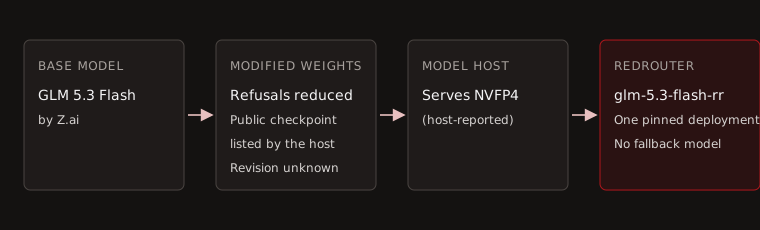
RR models are open-weight models with refusal behavior reduced. RedRouter does not add a refusal layer on top. For this model, the host lists the weights as dealignai/GLM-5.3-Flash-UNCENSORED-FP8 on Hugging Face, under the MIT license.
Some things are not verified, so they are stated plainly here:
- The exact weight revision, tokenizer and chat template are unknown to RedRouter.
- The weights are listed as FP8, but the host reports serving them quantized to NVFP4. Lower-precision quantization can change output quality.
- RedRouter has not confirmed that this checkpoint matches any specific upstream GLM 5.3 Flash release.
"Reduced refusals" is not "no refusals". The model can still decline, and it can still be wrong.
Try it
curl https://redrouter.org/v1/chat/completions \
  -H "Authorization: Bearer $REDROUTER_API_KEY" \
  -H "Content-Type: application/json" \
  -d '{
    "model": "glm-5.3-flash-rr",
    "max_tokens": 4096,
    "messages": [{"role": "user", "content": "Write a YARA rule for a PE file that imports VirtualAllocEx and WriteProcessMemory."}],
    "stream": true
  }'
Run on October 27, 2026. glm-5.3-flash-rr returned a rule and notes; the rule:
import "pe"

rule Process_Injection_VirtualAllocEx_WriteProcessMemory
{
    meta:
        author      = "Your Name"
        description = "PE file importing VirtualAllocEx and WriteProcessMemory (common injection pattern)"
        date        = "2024-01-01"
        reference   = "MITRE ATT&CK T1055 - Process Injection"
        severity    = "medium"

    strings:
        $virtualallocex   = "VirtualAllocEx" ascii
        $writeprocessmem  = "WriteProcessMemory" ascii
        $createremotethr  = "CreateRemoteThread" ascii
        $createremotethrex = "CreateRemoteThreadEx" ascii

    condition:
        uint16(0) == 0x5A4D and                    // MZ header - it's a PE file
        pe.number_of_sections > 0 and
        pe.is_pe and
        pe.imports("kernel32.dll", "VirtualAllocEx") and
        pe.imports("kernel32.dll", "WriteProcessMemory")
}
Base-model benchmarks
These are published results for the base GLM 5.3 Flash, not for the RedRouter modified version. RedRouter has not reproduced them.
| Benchmark | Base GLM 5.3 Flash | Base GLM 5.3, for scale | Source (read October 27, 2026) |
|---|---|---|---|
| Terminal-Bench 2.1 | 84.3 | 88.2 | Z.ai model card |
| DeepSWE v1.1 | 63.4 | not published | Z.ai GLM 5.3 Flash post |
| HunterBench | 328 / 1000 | 415 / 1000 | HunterBench |
HunterBench splits Flash's score into 130 for coverage and 198 for exploitation; the full-size model scores 113 and 302. Flash covers slightly more of the target and exploits less of it.
When to pick something else
Flash is the cheapest model here and the one to start with. Move up to GLM 5.3 RR when a task needs the depth of the full-size model and you will pay roughly seven times the input price for it. Try DeepSeek V4.1 Flash RR when you want its abliterated checkpoint or simply prefer its answers on your task; it costs about the same. On published base-model benchmarks the full-size GLM leads Flash, as the table above shows, but those are base scores, not the RR versions.
FAQ
Does it support tools and JSON mode? Yes to both, per the table above. Tool calls follow the OpenAI tools format, and the model also works through the Anthropic Messages endpoint for Claude Code. See the agent setup guide.
Is my data kept? By default, an encrypted copy of prompts and completions is kept for up to 30 days for abuse prevention, support, debugging and billing disputes. Zero Data Retention stops that. See the privacy policy.
What may I use it for? Anything legal. Testing systems you do not own or are not authorized to test is against the terms.