 redrouter


If you're looking for a Venice AI alternative because your work is pentests, red-team engagements or bug bounty, the useful comparison isn't model count. It's four narrower things: which API format your security agent speaks, what happens to client data, what the license lets you do on paid work, and what the terms say about testing other people's systems.
Everything about Venice below comes from Venice's own pages (its docs, API index and terms of service), read on November 9, 2026. Everything about RedRouter comes from docs.redrouter.org and our terms, read the same day. Both change, so recheck before you move client work.
This is for authorized work only: systems you own, or systems you have written permission to test.
What Venice AI is, in its own words
Venice describes itself as "private and uncensored ai" for text, image, video, audio and code. Its API docs offer an OpenAI-compatible API at https://api.venice.ai/api/v1 covering chat, images, audio, video, embeddings and web tools, with a catalog of "390+ models" across those modalities. It sells consumer plans as well as pay-as-you-go API credits.
On privacy, Venice's privacy page says its proxy doesn't store prompt or response content for normal inference, and labels each model with one of four modes: anonymous, private, TEE or E2EE. The labels matter for what follows. "anonymous" means Venice hides your identity from the model provider, but in Venice's words, "prompt content is still visible to that provider."
Its own text model, Venice Uncensored 1.2, is described as "designed for maximum creative freedom and authentic interaction", built for "open-ended exploration, roleplay, and unfiltered dialogue." The catalog also lists third-party models, including abliterated variants of open-weight bases.
Where a Venice AI alternative matters for security work
1. The license on paid engagements
Section 7.1 of Venice's terms of service (last updated June 8, 2026) grants its license "solely for your personal, non-commercial use", and that grant covers generating API keys. If you bill a client for a pentest or red-team engagement, read that clause, and ask Venice or your own counsel how it applies, before you route client work through it. We're not lawyers and won't guess.
RedRouter's terms don't limit use to personal, non-commercial work. What they do prohibit is using the service to "attack, access, or test systems you do not own or are not authorized to test."
2. Claude Code, and which API it actually hits
Claude Code speaks Anthropic's Messages API. Venice's Claude Code guide has you install claude-code-router, a local proxy that converts Messages requests into Venice's OpenAI-compatible chat format. For text, Venice's API index lists Chat Completions and a beta Responses endpoint. We didn't find a native Messages endpoint there (November 9, 2026).
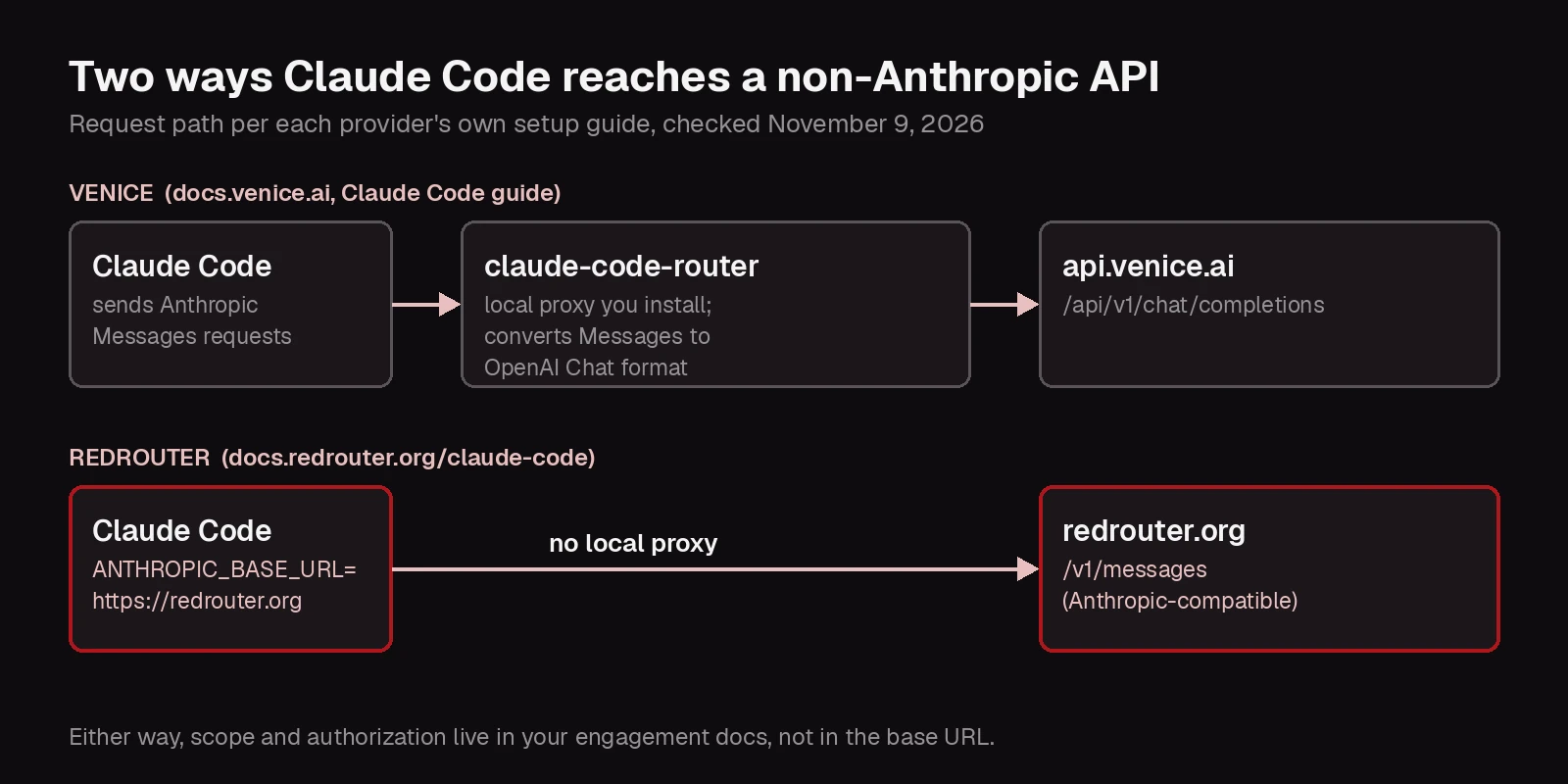
RedRouter serves an Anthropic-compatible Messages endpoint at https://redrouter.org/v1/messages, plus OpenAI-compatible Chat Completions and Responses at https://redrouter.org/v1. Claude Code points at it directly, with no local proxy to install, update or debug. One less moving part in the request path also means one less local log to check when you're cleaning up after an engagement.
3. Which model you're really talking to
The Claude models in Venice's Claude Code guide are third-party models. Venice's Claude Opus 4.8 page, for example, lists the provider as Anthropic and the privacy mode as "anonymized", which by Venice's own definition means the provider still sees the prompt content. Section 9.3 of the terms says third-party providers "may impose their own usage policies", and that Venice can restrict access when a provider requires it. Section 10.3 has you agree not to breach those provider policies. Put simply, a Claude model reached through Venice is still subject to Anthropic's usage policies.
That matters if the reason you're shopping for a Venice AI alternative is mid-task refusals on authorized work. We keep real examples in the refusal archive. RedRouter's Red models are open-weight models modified to refuse less, labeled Red, with no added refusal layer on top. It's explained in what is abliteration. Reduced refusals still aren't zero refusals, and no model's answer counts as evidence on its own.
Venice AI vs RedRouter, side by side
| Venice AI | RedRouter | |
|---|---|---|
| Stated focus | "private and uncensored AI" for text, image, video, audio and code | Low-refusal inference for authorized security work (security) |
| Modalities | Text, image, video, audio, embeddings, web tools | Text output; some models accept image input (models) |
| OpenAI-compatible API | Yes, api.venice.ai/api/v1 | Yes, redrouter.org/v1 (Chat Completions and Responses) |
| Anthropic Messages API | Not in its API index (Nov 9, 2026); Claude Code guide uses a local converting proxy | Yes, redrouter.org/v1/messages |
| Low-refusal models | Venice Uncensored 1.2 ("roleplay, and unfiltered dialogue") plus third-party uncensored variants | Modified Red models; standard open-weight models also listed |
| License scope | "personal, non-commercial use" (ToS 7.1) | No personal-only limit; testing only on systems you own or are authorized to test |
| Content storage | No content storage for normal inference, per its privacy page; per-model modes | New API keys store no content; Chat stores content; Zero Data Retention is an opt-in switch in Settings, off by default; see pricing for account eligibility |
| Model substitution | Catalog can change; access to a model can be restricted (ToS 9.3) | Each request uses the model ID you named; no silent model substitution |
| Hardware-isolated / E2EE modes | Per-model TEE and E2EE labels (privacy) | Confidential Inference available (hardware-isolated, attested); contact support for models (private vs confidential inference) |
No price table here. Per-token prices move too often, and price isn't what decides a security workflow.
Data handling, without the marketing
Treat this part of any Venice AI alternative comparison as something to verify, not something to take on trust.
RedRouter's data handling page says new API keys default to content storage off, older keys keep storage on, and browser Chat and the Mac app store content unless account Zero Data Retention is on. When storage is on, prompts and completions are encrypted for up to 30 days for abuse prevention, support, debugging and billing disputes, and backups may persist up to seven more days. Zero Data Retention is an opt-in switch in Settings, off by default; see pricing for account eligibility. Usage metadata such as model, tokens, cost and timing is still recorded either way. The details are in what RedRouter keeps.
Venice's privacy page says it can process operational metadata too, including API key identifiers, timestamps, model, token counts, IP address and request IDs.
The same habits apply to either provider. Strip credentials, session cookies and customer personal data before they reach a prompt. Check your agent's local transcripts and debug logs. Neither provider's settings delete copies your own tools keep. If you're weighing hardware-isolated inference, read private inference vs confidential inference before you rely on any label.
Switching a security agent from Venice to RedRouter
If you need a Venice API alternative for Claude Code or OpenCode, the cutover is a base URL and model ID change. For Claude Code, set the base URL to the origin. Claude Code appends /v1/messages itself:
export REDROUTER_API_KEY="your-redrouter-api-key"
export ANTHROPIC_BASE_URL="https://redrouter.org"
export ANTHROPIC_AUTH_TOKEN="$REDROUTER_API_KEY"
export ANTHROPIC_API_KEY=""
export ANTHROPIC_MODEL="glm-5.3-flash-red"
export ANTHROPIC_DEFAULT_SONNET_MODEL="glm-5.3-flash-red"
export ANTHROPIC_DEFAULT_OPUS_MODEL="glm-5.3-flash-red"
export ANTHROPIC_DEFAULT_HAIKU_MODEL="glm-5.3-flash-red"
export CLAUDE_CODE_SUBAGENT_MODEL="glm-5.3-flash-red"
claude --permission-mode plan
If you used claude-code-router only to reach Venice, you can stop it for this profile. Keep manual permission prompts on.
For OpenCode, the change from a Venice opencode.json is the provider block: baseURL becomes https://redrouter.org/v1, the key env var becomes REDROUTER_API_KEY, and the model ID becomes one from the catalog. The full config is in our OpenCode and Cline guide.
GLM 5.3 Flash Red is the usual starting point for agent work: $0.20 input, $0.08 cached input and $0.80 output per 1M tokens, a 1,048,576-token context, 8,192 output tokens per request, and tool calling (docs.redrouter.org/models, November 9, 2026). Other models are on the pricing page.
Before the first real run:
- Put the written scope in the working directory.
- Turn on Zero Data Retention in Settings if client data will touch prompts.
- Send one nonsensitive request and check the model ID in the Usage dashboard.
- Only then give the agent tools, files or a proxy session. The Claude Code and burp workflow shows an offline first pass.
When RedRouter isn't the Venice AI alternative you need
- You need image, video, music or voice generation. RedRouter's models return text.
- You want Anthropic's Claude models. They aren't in RedRouter's catalog. If you want to keep Claude as the planner and only hand refused subtasks to a modified model, see the broker pattern.
- Your work isn't authorized. Both providers' terms prohibit illegal use, and we won't help with it.
If your current provider for general use is OpenRouter rather than Venice, the same tradeoffs are in OpenRouter uncensored models vs a security API.
FAQ
Is there a Venice AI alternative for pentesting and red teaming?
Yes. RedRouter is built for authorized pentests, red teams and bug bounty, with modified low-refusal open-weight models behind OpenAI-compatible and Anthropic-compatible APIs. The terms limit testing to systems you own or are authorized to test.
Can I use Venice AI with Claude Code?
Venice's own guide routes Claude Code through claude-code-router, a local proxy that converts Messages requests to Venice's Chat Completions format. RedRouter accepts Claude Code's Messages requests directly at https://redrouter.org.
Does RedRouter store my prompts?
New API keys store no prompt or completion content. Browser Chat, the Mac app and older keys store encrypted content for up to 30 days unless you turn on Zero Data Retention. Backups may persist up to seven more days. Zero Data Retention is an opt-in switch in Settings, off by default; see pricing for account eligibility. Usage metadata is still kept.
Is Venice Uncensored good for security research?
Venice describes Venice Uncensored 1.2 as built for creative freedom, roleplay and unfiltered dialogue. It doesn't describe it as a security model. Whichever model you pick, test it on your own authorized tasks and verify its output against tool evidence.
Sources
All read November 9, 2026.
- Venice home page ("private and uncensored ai"): https://venice.ai/
- Venice API overview: https://docs.venice.ai/overview/about-venice
- Venice privacy: https://docs.venice.ai/overview/privacy
- Venice Claude Code guide: https://docs.venice.ai/guides/integrations/claude-code
- Venice API index: https://docs.venice.ai/llms.txt
- Venice Uncensored 1.2: https://docs.venice.ai/models/venice-uncensored-1-2
- Venice Claude Opus 4.8: https://docs.venice.ai/models/claude-opus-4-8
- Venice terms of service (last updated June 8, 2026): https://venice.ai/legal/tos
- claude-code-router: https://github.com/musistudio/claude-code-router
- RedRouter Claude Code recipe: https://docs.redrouter.org/claude-code
- RedRouter data handling: https://docs.redrouter.org/data-handling
- RedRouter models and prices: https://docs.redrouter.org/models
- RedRouter terms: https://redrouter.org/terms
- Cover photo: "Padlocked lower gates, Claydon Top Lock, Oxford Canal" by Mertbiol, CC0 1.0, via Wikimedia Commons