 redrouter


The best LLM for Strix is the one that keeps calling tools for hundreds of turns, doesn't refuse offensive work, and doesn't cost more than the finding is worth. Strix doesn't ship a model. You pick one with STRIX_LLM, and that choice decides more about your results than any flag you pass. Independent tests have shown the same Strix version finding many issues on one model and almost none on another.
This guide covers what Strix needs from a model, what Strix itself recommends, what published tests found, and what a Strix scan costs, worked out from real token counts. It also shows where RedRouter's models fit for authorized testing.
What we checked, on November 20, 2026: the Strix repository at commit a1ccf77 (November 19, 2026; v1.7.1 is the latest release, from November 10), the live Strix LLM provider docs, RedRouter's model catalog, and the independent write-ups linked below. The cost figures for RedRouter models are arithmetic on token counts other people published, not scans we ran.
What Strix needs from a model
Strix runs a team of agents in a Docker sandbox, and every step is a tool call. Four things separate a model that works from one that stalls:
- Native tool calls. Strix sends roughly 30 tools on each turn. The local models guide says "every working turn must be a native function/tool call," and a call returned as plain text makes no progress.
- Long-horizon behavior. A run only ends when the model calls a finish tool. Models that wrap up early or wander leave coverage on the table.
- Low refusals. Strix's docs say frontier OpenAI, Anthropic and Gemini models need a cyber access program before they'll do offensive work. Our Strix refusals guide covers what that looks like in a run.
- A big context window. Strix compacts history automatically, and when it can't look up a model's window it assumes 200,000 tokens (
STRIX_CONTEXT_FALLBACK_TOKENS). Long scans feed it tool output, HTTP responses and source code, so more room helps.
What Strix recommends
The Strix provider overview, checked November 20, 2026, marks one model as recommended and lists several others:
| Model | STRIX_LLM value |
|---|---|
| GLM-5.3 (recommended), via Vercel AI Gateway | vercel_ai_gateway/zai/glm-5.3 |
| GLM-5.3 (recommended), via OpenRouter | openrouter/z-ai/glm-5.3 |
| GPT-6.1 Sol | openai/gpt-6.1-sol |
| Claude Opus 5.5 / Sonnet 5.5 | anthropic/claude-opus-5-5, anthropic/claude-sonnet-5-5 |
| Gemini 4 Argon | vertex_ai/gemini-4-argon |
| DeepSeek V4.1 Flash / V4 Pro | deepseek/deepseek-flash, deepseek/deepseek-v4-pro |
| Kimi K3.1 Pro | moonshot/kimi-k3.1-pro |
The same page notes that the OpenAI, Anthropic and Gemini entries need Daybreak, the Cyber Verification Program or the Fairwind Program respectively for security testing.
What independent Strix model tests found
Vendor benchmarks only tell you so much. These are the published tests we could verify:
- 18 models, one lab (TheArtificialQ, April 14, 2026). The author ran Strix 0.8.3 against his own two-app test server with 18 models, three runs each, scoring by summed CVSS of unique findings. GLM 5.1 came out well ahead, GPT-5.4 second. His main takeaway: "for serious testing with Strix, you need to use big (and expensive) LLM models," with most cheap models clustered in "the same mediocre range." Claude Sonnet 4.6 on Anthropic's Tier 1 limits hit the 30,000 input-tokens-per-minute limit 105 times in one run and spent about $20 before he stopped it; a second run through OpenRouter scored 40.8 and cost $55.90.
- Same model, different tools (Escape, April 30, 2026). Escape's benchmark ran Strix, Shannon and PentAGI on DeepSeek v3.2 against its Duck Store target. Strix found 1 of 20 issues, Shannon 6 and PentAGI 9. The model isn't the only variable, and that version of Strix is several releases old.
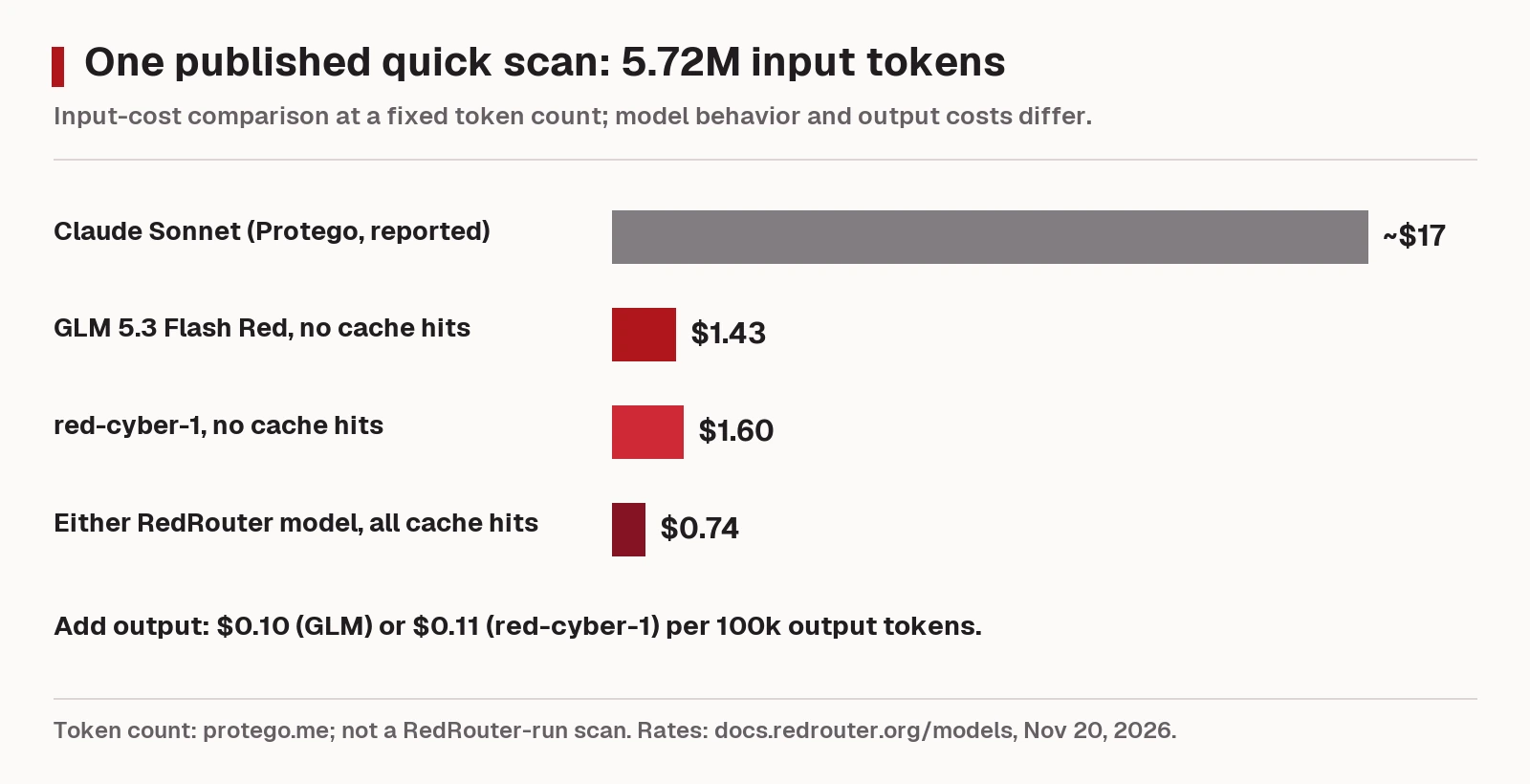
- Field reports. A Protego review of a quick black-box scan on Claude Sonnet logged 105 model requests and 5,716,615 input tokens in about ten minutes, roughly $17, with no confirmed findings and the API key auto-disabled. Brunovski ran a deep scan of crAPI on
openai/gpt-4o: 275 requests, about 7.4M tokens, 16 minutes 38 seconds, $4.57. Steven Hostetler puts a typical quick scan at $10 to $15 and found Gemini 3.1 Pro Preview worked best for him after Gemini 3.6 Flash refused.
The pattern across all of them: model quality matters most, refusals and rate limits waste money before they waste time, and token counts per scan run into the millions even in quick mode.
Strix cost per scan: the math
A Strix scan is mostly input tokens. Every turn resends the plan, earlier tool output and page contents, so the input side grows turn by turn while output stays small. That makes the cached-input price and the cache hit rate as important as the headline rate.
Here is the Protego quick scan (5,716,615 input tokens) and the Brunovski deep scan (about 7.4M total tokens, not split into input and output) priced at RedRouter's rates on docs.redrouter.org/models, checked November 20, 2026:
| Model | Price per 1M (input / cached / output) | 5.72M input, no cache hits | 5.72M input, all cache hits | 7.4M tokens, priced at the input rate |
|---|---|---|---|---|
| GLM 5.3 Flash Red | $0.25 / $0.13 / $1.00 | $1.43 | $0.74 | $1.85 |
| red-cyber-1 (Beta) | $0.28 / $0.13 / $1.10 | $1.60 | $0.74 | $2.07 |
Brunovski did not break out input vs output, so the last column bills the whole ~7.4M at the input rate as an illustrative input-only scenario, not a total-cost estimate; output tokens cost more, while reported cache reads cost less. For the Protego columns, add output on top: every 100,000 output tokens costs $0.10 on GLM 5.3 Flash Red and $0.11 on red-cyber-1. The input charge for that token count lands between the no-cache and all-cache columns, since RedRouter bills the cached rate only for cache reads the model reports and doesn't guarantee hits (prompt caching).
Two caveats keep this honest. First, these are someone else's token counts on someone else's target. A different model may take more or fewer turns to reach the same coverage, so cost per finding matters more than cost per token. Second, nobody has published a Strix benchmark of RedRouter's models. RedRouter's own compatibility check ran Strix 1.7.0 against an OWASP Juice Shop fixture with deepseek-v4.1-flash-red and reported a demonstrated login SQL injection, which shows the setup works, not how it ranks.
Rate limits cost more than they look
TheArtificialQ's Sonnet run shows what a per-minute token cap does to an agent that sends millions of tokens. Strix retries HTTP 429, 500, 502, 503 and 504 up to five times per request, with a backoff that starts at 2 seconds and doubles to a 90-second ceiling (DEFAULT_MODEL_RETRY in strix/config/models.py). If those run out, Strix's agent loop gets a few more transient retries of its own before the agent fails. Pick a provider tier whose per-minute limit fits a multi-agent run, or the scan spends its time waiting. RedRouter's rate limits and usage tiers page lists the limits that apply to your key.
Choosing the best LLM for Strix
- For authorized pentests where refusals are the blocker: red-cyber-1 (Beta), described in RedRouter's catalog as the featured model for authorized penetration testing and red-team work, "with reduced refusals, a long context window, tool calling, and structured output."
- For lower cost on long runs: GLM 5.3 Flash Red, $0.25 / $0.13 / $1.00 per 1M tokens (model page). It's a separate catalog model from the GLM-5.3 that Strix recommends; don't assume the results carry over.
- If you're already approved for a frontier program: use the model your organization cleared. That's what Strix's docs point to.
- For air-gapped work: a local model, with the trade-offs in our Strix with Ollama guide.
Whatever you pick, test it the same way: a deliberately vulnerable lab app you own, --scan-mode quick, --max-turns 60 and a --max-budget you'd be fine losing. Compare the report with the vulnerabilities you know are there. Two or three runs per model tell you more than a leaderboard.
Set the model and the prices
Both RedRouter models are text-only with tool calling, a 1,048,576-token context window and an 8,192-token default output:
export STRIX_LLM=openai/glm-5.3-flash-red      # or openai/red-cyber-1
export LLM_API_KEY="$REDROUTER_API_KEY"
export LLM_API_BASE=https://redrouter.org/v1
export STRIX_API_TYPE=chat_completions
export STRIX_MAX_CONTEXT_IMAGES=0

export STRIX_LLM_INPUT_COST_PER_MTOK=0.25          # red-cyber-1: 0.28
export STRIX_LLM_CACHED_INPUT_COST_PER_MTOK=0.13   # red-cyber-1: 0.13
export STRIX_LLM_OUTPUT_COST_PER_MTOK=1.00         # red-cyber-1: 1.10
LiteLLM can't price a custom model ID, so without the three cost variables Strix's spend estimate and --max-budget read near zero. Our Strix OpenAI-compatible API guide explains each variable, and RedRouter's inference API page covers the endpoint itself. Prices change, so copy them from the models docs when you set them.
Scan traffic can include credentials and customer data. New RedRouter API keys default to content storage off, and Zero Data Retention is an opt-in account setting; check the current eligibility terms (details).
FAQ
What is the best LLM for Strix?
It depends on your constraints. Strix recommends GLM-5.3 through Vercel AI Gateway or OpenRouter. An 18-model independent test found GLM 5.1 well ahead of the rest. For authorized pentesting where refusals stall scans, RedRouter's red-cyber-1 (Beta) is built for that work. Test any choice on a lab target first.
How much does a Strix scan cost?
Published runs range from $4.57 for a 16-minute deep scan on GPT-4o to about $17 for a ten-minute quick scan on Claude Sonnet and $55.90 for a Sonnet run through a reseller. The same 5.7M input tokens price at $0.74 to $1.43 on GLM 5.3 Flash Red before output, depending on cache hits.
Why are Strix scans so token-hungry?
Every agent turn resends the growing context: the plan, earlier tool output and pages the agent has read. Several sub-agents run at once, so input tokens climb fast. Cached input pricing and a --max-budget cap both matter.
Can I use a cheap model with Strix?
You can, but independent testing found that cheap models mostly cluster at lower scores. A cheap model that misses findings or refuses isn't a saving. Measure cost per finding, not cost per token.
Does Strix work with GLM 5.3 Flash Red?
It accepts any model with tool calling that the endpoint serves. Use STRIX_LLM=openai/glm-5.3-flash-red with LLM_API_BASE=https://redrouter.org/v1. RedRouter's published Strix check used deepseek-v4.1-flash-red, so validate GLM 5.3 Flash Red on a lab target yourself.
Sources
- Strix: repository (commit
a1ccf77), v1.7.1 release, LLM providers overview, local models, configuration. Checked November 20, 2026. - Independent tests: TheArtificialQ, 18 LLM models (April 14, 2026); Escape benchmark (April 30, 2026); Protego review; Brunovski; Steven Hostetler.
- RedRouter Docs: Models and pricing, Prompt caching, Security agents, Rate limits. Checked November 20, 2026.