 redrouter


Strix model refusals can make a scan of your own app find nothing. The agent starts, the sandbox comes up, and then the model declines to write the exploit, wraps up early, or keeps apologizing until the run ends. Strix's own documentation says it plainly: frontier OpenAI, Anthropic and Gemini models "need a cyber access program for security testing," and without one, the OpenAI page adds, "the models refuse most offensive tasks."
This guide shows the three ways a refusal shows up in Strix, how to tell which one you hit, and how to fix it, either by getting your current provider's cyber access or by pointing STRIX_LLM at a model built for authorized security work, such as RedRouter's.
What we checked, on November 20, 2026: the Strix repository at commit a1ccf77 (November 19, 2026, six commits after the v1.7.1 release), its refusal and retry handling in strix/core/execution.py, strix/config/codex.py and strix/config/models.py, and the live Strix LLM provider docs. We ran Strix's own model-preflight code from that commit against a local mock server to confirm how STRIX_LLM routes. We did not run a full scan against a refusing production model.
Only scan systems you own, isolated labs, or targets you have written permission to test. A model that stops refusing doesn't change what you're authorized to touch. Our terms prohibit unauthorized testing.
Why Strix models refuse
Strix is an autonomous pentest agent. Every working turn asks the model to do something offensive on purpose: enumerate an attack surface, craft a SQL injection payload, chain an IDOR into account takeover, write a proof of concept. General-purpose models from the large labs run safety classifiers over exactly that kind of request, and they can't see your engagement letter.
Strix's provider docs name the programs that lift those limits:
| Provider | Program named in the Strix docs | What the Strix docs say happens without it |
|---|---|---|
| OpenAI | Daybreak (Trusted Access for Cyber) | "the models refuse most offensive tasks" |
| Anthropic | Cyber Verification Program (CVP) | "the safety classifiers block most offensive tasks" |
| Google Gemini | Fairwind Program | listed as required for security testing |
Routing through a gateway doesn't get around this. The Strix OpenRouter page notes that OpenAI, Anthropic and Gemini models "keep their provider safeguards on OpenRouter."
Users see it in practice. In an August 24, 2026 r/bugbounty thread, a hunter running Strix on a GPT model reported that it "frequently returns no results on targets I know have easily identifiable CVEs," and the first reply suspected OpenAI guardrails. In his Strix write-up, Steven Hostetler wrote that Gemini 3.6 Flash "hit guardrails that can't be bypassed" and refused to scan.
Three ways a refusal shows up in Strix
Strix handles a refusal differently depending on how the provider delivers it. Knowing which one you have tells you where to look and what it's costing you.
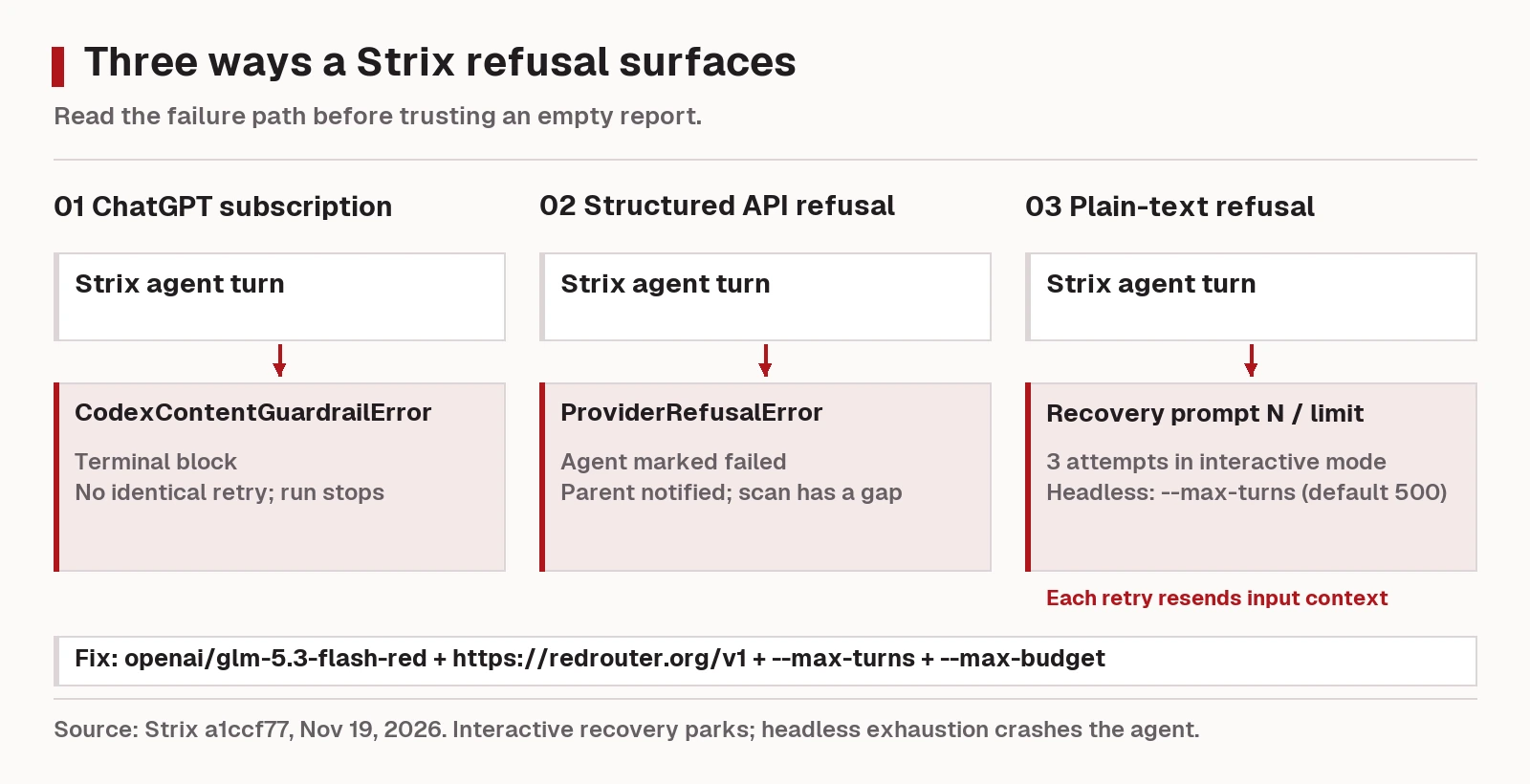
1. A hard block from the ChatGPT backend
If you signed in with a ChatGPT subscription instead of an API key, a blocked request raises CodexContentGuardrailError. Strix looks for the strings "flagged for possible cybersecurity risk" and "trusted access for cyber" in the provider's error, and the message you get reads:
'<model>' was blocked by ChatGPT's content guardrails (flagged as a possible
cybersecurity risk). Set STRIX_LLM to a model that isn't blocked and re-run.
The code comment calls this terminal: "retrying identical content never clears the block." Strix's retry policy skips it on purpose. This is the easy case, since it fails loudly and tells you the fix.
2. A structured refusal from the API
Some APIs return a refusal as its own content type instead of an error. Strix checks every model reply for a refusal content part. When it finds one, it raises ProviderRefusalError, logs agent <id> refused by the model provider: <text> to strix.log in the run folder, marks that agent failed, and tells the parent agent. The scan keeps going, but whatever that sub-agent was testing doesn't get tested.
That's why a refusing model often produces a clean-looking report. The root agent finishes, a few children quietly failed, and penetration_test_report.md lists fewer findings than it should.
3. A refusal in plain text
The most expensive version is the model answering "I can't help with that" as ordinary text. Strix doesn't treat that as a refusal at all. Its run loop only ends on a lifecycle tool call (finish_scan, agent_finish, wait_for_user or wait_for_agents), and the docstring is blunt: "plain text never terminates a run." A text-only turn gets a recovery prompt instead, starting with "Your previous response ended the autonomous run without a lifecycle tool call," followed by "This is recovery attempt N/limit."
In interactive mode the limit is 3, after which the agent parks until you message it. In headless mode (-n), the limit is your --max-turns value, which defaults to 500, and an agent that runs out is marked crashed. Until then, a model that keeps refusing keeps receiving recovery prompts, and every one resends the growing conversation, which you pay for in input tokens. Strix logs each one to strix.log as "ended a turn without a lifecycle tool call ... forcing tool continuation (N/limit)". If you've ever watched a Strix scan sit for an hour with the token counter climbing and nothing in the report, this is a likely cause.
How to tell which refusal you hit
Every scan writes to strix_runs/<run-name>/. Start with these checks:
RUN=strix_runs/<run-name>

# Structured refusals (case 2)
grep -n "refused by the model provider" "$RUN/strix.log"

# Plain-text refusal loops (case 3)
grep -n "forcing tool continuation\|exhausted recovery attempts\|exhausted tool-call recovery" "$RUN/strix.log"

# ChatGPT guardrail blocks (case 1)
grep -n "content guardrails" "$RUN/strix.log"
Then compare what the agents were asked to do with what they reported. If an agent named for SQL injection or authentication testing failed early and the report has nothing in that class, treat the result as incomplete, not as a clean bill of health.
A refusal can also be partial. A model may run recon happily and then stop at exploitation, or report a "potential" issue without the proof of concept Strix's reporting tool asks for. Those runs don't log anything unusual, so the only signal is a thin report on a target you know is vulnerable. Run new model choices against a deliberately vulnerable lab app first, so you know what a full report looks like.
Fix 1: Get cyber access from your current provider
If you're tied to OpenAI, Anthropic or Google for policy or quality reasons, apply for the program in the table above and wait for approval before you rely on Strix results. This is the only way to keep using those models for offensive testing. It takes an application and review, and access is granted per organization, so it doesn't help a solo tester who needs to run a scan this afternoon.
Fix 2: Point Strix at a model built for security work
The other fix is to change STRIX_LLM to a model that doesn't refuse authorized offensive work in the first place. RedRouter serves models through an OpenAI-compatible API for exactly this. Its model catalog describes red-cyber-1 (Beta) as "the featured model for authorized penetration testing and red-team work, with reduced refusals, a long context window, tool calling, and structured output." Reduced refusals is not the same as none, and a model that never says no is also not a substitute for scope.
export STRIX_LLM=openai/glm-5.3-flash-red      # or openai/red-cyber-1
export LLM_API_KEY="$REDROUTER_API_KEY"
export LLM_API_BASE=https://redrouter.org/v1
export STRIX_API_TYPE=chat_completions
export STRIX_MAX_CONTEXT_IMAGES=0

# Price the model so --max-budget works (USD per 1M tokens)
export STRIX_LLM_INPUT_COST_PER_MTOK=0.25          # red-cyber-1: 0.28
export STRIX_LLM_CACHED_INPUT_COST_PER_MTOK=0.13   # red-cyber-1: 0.13
export STRIX_LLM_OUTPUT_COST_PER_MTOK=1.00         # red-cyber-1: 1.10

strix -n --target http://127.0.0.1:3000 --scan-mode quick \
  --max-turns 60 --max-budget 2 \
  --instruction-file ./scope.txt
What each line does, as of Strix commit a1ccf77:
openai/prefix. We ran Strix's preflight against a mock server. With theopenai/prefix, Strix uses the OpenAI Agents SDK's own client, not LiteLLM, strips the prefix, and sendsPOST /v1/chat/completionswith the bare model ID and a bearer token.LLM_API_BASEwith/v1. When we dropped/v1, the request went to/chat/completionsat the host root, which returns 404 on RedRouter.STRIX_API_TYPE=chat_completions. For an ID LiteLLM doesn't know, Strix already picks Chat Completions. But when we used an ID that LiteLLM lists as a Responses model (openai/gpt-5) with a custom base URL, Strix sentPOST /v1/responses. Setting the type explicitly removes the guess.STRIX_MAX_CONTEXT_IMAGES=0. Strix assumes a model it can't look up accepts images, and keeps up to 3 screenshots in context by default. Both RedRouter models here are text-only, so turn that off.- Prices. GLM 5.3 Flash Red costs $0.25 per 1M input tokens, $0.13 per 1M cached input tokens and $1.00 per 1M output tokens on the GLM 5.3 Flash Red model page. red-cyber-1 (Beta), the featured model for authorized pentesting, costs $0.28 / $0.13 / $1.10 on the red-cyber-1 model page. Both have a 1,048,576-token context window, tool calling and an 8,192-token default output. LiteLLM can't price a custom ID, so without these variables
--max-budgetreads near zero. Prices change, so copy them from docs.redrouter.org/models when you set the variables.
Our full Strix setup guide covers dedupe, error messages and the rest of the configuration, and best LLM for Strix compares models by cost per scan.
Fix 3: Make the authorization explicit
Strix takes free-text rules through --instruction or --instruction-file. Use them to state the scope and the authorization, not to argue with a model. A short scope file gives any model the context a human tester would get, and it keeps the agent from wandering:
Authorized test of an application we own. Written approval on file.
In scope: http://127.0.0.1:3000 and the source in ./app only.
Do not contact any other host, including links found in source or responses.
Report each finding with evidence, the request that triggered it, and your confidence.
This helps a capable model that's merely cautious. It won't move a provider whose classifier blocks the request before the model sees it, and you shouldn't try to talk one past its policy. If a model only cooperates after you lie to it about scope, you're using the wrong model.
Fix 4: Cap the run so refusals can't burn your budget
Because a plain-text refusal can loop up to --max-turns times in headless mode, set both caps on every new model:
--max-turns(default 500 per agent). Something like 60 is plenty for a first lab run.--max-budget(also--max-budget-usd). In headless mode the scan stops cleanly when estimated spend reaches the cap, and sub-agents stop at 90% so the root agent can write the report. The CLI reference notes the check runs after each response, so concurrent calls can overshoot slightly.
The budget only works if Strix knows the price, which is why the three STRIX_LLM_*_COST_PER_MTOK variables above matter.
What happens to scan data
Strix sends tool output, HTTP responses and source snippets to the model on every turn, and on a real target that can include credentials or customer data. RedRouter API keys have a per-key store_content setting, and new keys default to storage off. Zero Data Retention is an opt-in account setting; check the current eligibility terms; zero data retention and what RedRouter keeps explain what it covers. Strix also keeps its own logs in strix_runs/, and Strix telemetry is on by default until you set STRIX_TELEMETRY=0.
Related Strix guides
- Use Strix with an OpenAI-compatible API: every environment variable,
--max-budgetpricing, dedupe and endpoint errors. - Best LLM for Strix, and what a scan costs: independent results across models and the per-scan math.
- Run Strix with Ollama and local models: when you can't send scan data off the machine.
- Strix vs Shannon, PentestGPT and CAI: how the open-source agents differ.
- Run Strix in GitHub Actions against staging: CI scans with a scoped spec.
FAQ
Why does Strix find nothing on a target I know is vulnerable?
One possible cause is a model that refuses offensive tasks. Check strix.log for "refused by the model provider" and "forcing tool continuation" lines, and test the same model on a deliberately vulnerable lab app. If it finds nothing there either, change STRIX_LLM.
Does Strix retry a refused request?
It doesn't retry a ChatGPT content-guardrail block, and a structured refusal marks the agent failed. A refusal written as plain text gets recovery prompts, up to 3 in interactive mode and up to --max-turns in headless mode.
Do I need OpenAI Daybreak or Anthropic CVP to use Strix?
Only if you want to use frontier OpenAI, Anthropic or Gemini models for offensive testing. Strix's docs say those models need the provider's cyber access program. Other models, including those served by RedRouter, don't.
Which RedRouter model should I use for Strix?
Start with GLM 5.3 Flash Red, or red-cyber-1 (Beta), the featured model for authorized pentesting. Both have tool calling and a 1,048,576-token context window. RedRouter's own Strix check on Strix 1.7.0 used deepseek-v4.1-flash-red, so run a short lab scan with your choice first.
Is it legal to make Strix stop refusing?
Using a model with fewer refusals is legal. Pointing Strix at a system you aren't authorized to test isn't, no matter which model you use. Keep written authorization and pass the scope to Strix.
Sources
- Strix: repository (commit
a1ccf77, November 19, 2026), v1.7.1 release, LLM providers overview, OpenAI, Anthropic, OpenRouter, configuration, CLI reference. Checked November 20, 2026. - Field reports: r/bugbounty, "Anyone using Strix?" (August 24, 2026); Steven Hostetler, AI-Native Pentesting with Strix.
- RedRouter Docs: Models and pricing, Security agents, Compatibility. Checked November 20, 2026.