 redrouter

Strix is the most-starred of the open-source AI pentest agents compared here, but it isn't the only one people compare it with. The usual shortlist is Strix vs Shannon, PentestGPT, CAI and PentAGI. They differ more than the star counts suggest: one needs your source code, one drives Claude Code or Codex instead of calling a model API, one is archived, and their licenses range from Apache-2.0 to AGPL-3.0 to research-only.
This comparison sticks to what each project's repository and docs say, plus the few published tests that ran more than one of them. We don't rank them on a single score, because no single test supports one.
What we checked, on November 20, 2026, at publication: each repository's README and its GitHub API metadata (stars, license, archive status, latest release), Strix at commit a1ccf77, and the independent write-ups linked below.
All of these tools send real attack traffic. Run them only against systems you own, isolated labs, or targets you have written permission to test.
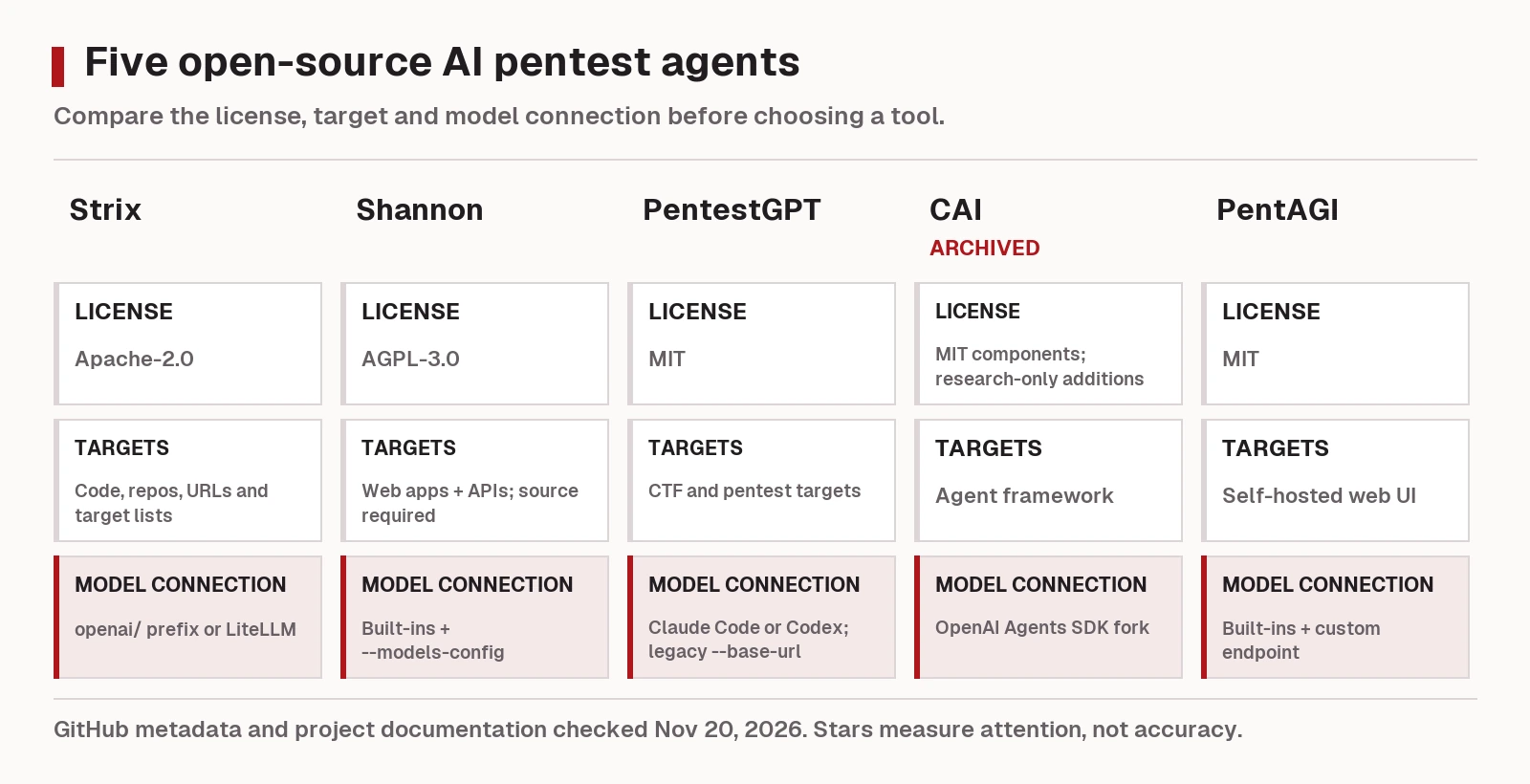
Strix vs Shannon, PentestGPT and CAI at a glance
| Strix | Shannon | PentestGPT | CAI | PentAGI | |
|---|---|---|---|---|---|
| Repository | usestrix/strix | KeygraphHQ/shannon | GreyDGL/PentestGPT | aliasrobotics/cai | vxcontrol/pentagi |
| License | Apache-2.0 | AGPL-3.0, commercial license available | MIT | MIT components plus proprietary additions "licensed for research purposes only" | MIT |
| GitHub stars (Nov 20, 2026) | 76,806 | 52,137 | 16,529 | 9,869 | 34,688 |
| Latest release | v1.7.1, Nov 10, 2026 | v3.6.1, Nov 20, 2026 | v1.0.0, Dec 24, 2025 | none; repository archived | v2.2.0, Oct 4, 2026 |
| Status | Active | Active | Last push Jul 14, 2026 | Archived; README says "no longer under active development" | Active |
| What it tests | Local code, GitHub repos, live web apps, multiple targets, target lists | Web apps and APIs, with source code | CTF and pentest targets | Agent framework with prebuilt red-team, bug bounty and DFIR agents | Pentest flows run from a self-hosted web UI |
| How it reaches a model | LiteLLM provider/model names, or the OpenAI client for openai/ IDs | Built-in Anthropic, OpenAI, xAI and Bedrock, other providers, custom base URL, --models-config | Autonomous mode drives Claude Code or Codex; legacy mode calls APIs directly | Built on the OpenAI Agents SDK | 10+ built-in providers plus custom OpenAI-compatible endpoints |
Strix
Strix describes itself as an "open-source AI penetration testing tool to find and fix your app's vulnerabilities." It runs a team of agents with a Kali-based Docker sandbox, a browser and an HTTP proxy, from a CLI that runs interactive or headless, and it has a GitHub Actions integration. Its benchmark page reports 96% (100 of 104) on the XBOW validation benchmark, for Strix v0.4.0 in black-box mode.
Things to weigh:
- Model setup is flexible. Any LiteLLM provider works, and an
openai/prefix withLLM_API_BASEpoints it at any OpenAI-compatible API. Our setup guide covers that end to end. - Results depend heavily on the model. Strix's docs say frontier OpenAI, Anthropic and Gemini models need a cyber access program before they'll do offensive work. See why Strix models refuse.
- Telemetry is on by default. Set
STRIX_TELEMETRY=0. An independent review found Strix reports vulnerabilities it finds to PostHog and Scarf unless you turn it off. - The PoC field isn't executed. Akshansh Jaiswal's code review traced Strix's required
poc_script_codefield and found it is stored and rendered but never run by Strix itself. Our own grep ata1ccf77found the field used only in the reporting tool, report writers and viewers. - Open core. Strix Cloud and Enterprise are paid; the CLI is free and you pay your model provider.
Shannon
Shannon, from Keygraph, is a white-box tester for web apps and APIs. Its README says it "analyzes your source code, identifies attack paths, and executes real exploits," and puts only findings with a working proof of concept in the report: "No exploit, no report." It mounts your repository read-only inside an ephemeral Docker worker.
- It needs source code. The open-source edition is built for apps whose code you have. For black-box testing, the README points to a separate Keygraph product.
- AGPL-3.0. That matters if you plan to modify it and offer it as a service. Keygraph sells commercial licenses and a hosted Pro edition at $50 per active developer per month.
- Runs take time and money. The README says a full run takes "roughly 1 to 1.5 hours" and may incur model costs.
- The same refusal problem. Shannon's README tells users to clear "cyber safeguards" with Anthropic and OpenAI before the first scan, because those safeguards "can interrupt a scan mid-run."
- Model setup. Anthropic, OpenAI, xAI and Bedrock are built in. Other models, including gateways and Ollama, vLLM or LM Studio, go through a custom base URL and a
--models-configfile. RedRouter's security agents page records a short compatibility check of Shannon 3.5.0 through that route.
PentestGPT
PentestGPT started as the human-in-the-loop research tool from a USENIX Security 2024 paper. Its current README describes an autonomous agent that "drives Claude Code or Codex to run tools," with a Docker image bundling both CLIs.
- You bring a Claude Code or Codex login, not just an API key. The autonomous pipeline is built for those two backends. The preserved "legacy" mode supports OpenAI, Anthropic, Gemini, DeepSeek, xAI, Qwen, Moonshot and local Ollama, with a
--base-urloption. - Slower release cadence. The latest GitHub release is v1.0.0 from December 24, 2025, and the last push was July 14, 2026.
- Benchmark claim with a caveat. The README reports 86.5% (90 of 104) on an XBOW validation-suite experiment in December 2025, and says that number is "a historical research result," not a current guarantee.
CAI
CAI (Cybersecurity AI), from Alias Robotics, is archived. The README says it is "no longer under active development," that development ran from March 2025 to August 2026, and that the history was consolidated into a single archival commit. Its license combines MIT-licensed code derived from the OpenAI Agents SDK "with proprietary additions licensed for research purposes only." The andpalmier review reported that CAI uploaded session transcripts by default. Read it as research material, not as a tool to adopt for client work.
PentAGI
PentAGI is a self-hosted platform with a web UI and a Docker Compose stack, MIT-licensed. It sits closer to an ops platform than a CLI scanner. We cover its setup in PentAGI with an OpenAI-compatible API.
What published tests found
Head-to-head tests are rare, and every one we found is small and dated:
- Escape (April 30, 2026) ran Strix, Shannon and PentAGI on DeepSeek v3.2 against its Duck Store app with the URL, OpenAPI spec and credentials. PentAGI found 9 of 20 issues in 4 hours, Shannon 6 of 20 in 6 hours with a 25% false-positive rate, and Strix 1 of 20 in 2 hours with no false positives. Escape, a commercial vendor, scored its own product highest.
- binsec field test. Patrick and Dominik Sauer ran Strix and PentAGI on real engagements and found Strix could find vulnerabilities but "neither reliable nor consistent," with an interface that "crashes from time to time" and a report with no fixed structure.
- Community. In an August 2026 r/bugbounty thread, one user found Strix weak on a GPT model while another reported good results on DeepSeek V4 Flash. A third recommended Shannon for consistency.
The honest reading: tool scaffolding matters, the model matters at least as much, and none of these agents is a replacement for a human tester yet. Strix and Shannon both depend on a model that won't refuse offensive tasks.
Which one to pick
- You have the source and want proof-backed web findings: Shannon, if AGPL-3.0 works for you.
- You want a permissive license and one CLI for code, repos, URLs and CI: Strix.
- You already pay for Claude Code or Codex and work CTF-style targets: PentestGPT's autonomous mode.
- You want a self-hosted web platform: PentAGI.
- CAI: read it, don't deploy it.
Running any of them on a model built for security work
Strix and Shannon both warn that frontier models need cyber access programs. RedRouter serves models for authorized security testing through an OpenAI-compatible API, so the same key works across tools: Strix's openai/ prefix, Shannon's custom model config, PentAGI's custom provider, and other harnesses. GLM 5.3 Flash Red costs $0.25 / $0.13 cached / $1.00 per 1M tokens (model page); red-cyber-1 (Beta), the featured model for authorized pentesting with reduced refusals, costs $0.28 / $0.13 / $1.10 (model page). Zero Data Retention is an opt-in account setting; check the current eligibility terms (details). For which model suits Strix specifically, see best LLM for Strix; for air-gapped work, see Strix with Ollama.
FAQ
Is Strix better than Shannon?
They do different jobs. Shannon is a white-box web and API tester that reports only exploited findings and needs your source. Strix accepts code, repositories and live URLs, runs black-box too, and is Apache-2.0. In Escape's April 2026 test on DeepSeek v3.2, Shannon found more issues than Strix on the same target.
Is CAI still maintained?
No. The repository is archived, and its README says CAI is no longer under active development.
Does PentestGPT work with an OpenAI-compatible API?
Its legacy mode accepts a --base-url. The autonomous mode drives Claude Code or Codex, so it uses those tools' own model connections.
What's the most popular open-source AI pentest tool?
Among the tools compared here, by GitHub stars on November 20, 2026: Strix (76,806), Shannon (52,137), PentAGI (34,688), PentestGPT (16,529) and CAI (9,869). Stars measure attention, not accuracy.
What is a good Strix alternative?
Shannon for white-box web apps, PentAGI for a self-hosted platform, or PentestGPT if you work through Claude Code or Codex. If Strix itself is fine but the model refuses, changing STRIX_LLM may be the fix you need, not a new tool.
Sources
- Repositories and GitHub API metadata, checked November 20, 2026: Strix (commit
a1ccf77; benchmarks), Shannon, PentestGPT, CAI, PentAGI. Strix docs: LLM providers. - Independent reviews and tests: Escape benchmark (April 30, 2026); binsec field test; Akshansh Jaiswal, The Verification Gap; andpalmier, Beyond ARTEX; r/bugbounty thread (August 24, 2026).
- RedRouter Docs: Models and pricing, Security agents. Checked November 20, 2026.