 redrouter


If you're looking for a Refuseless alternative for pentests, red-team engagements or bug bounty, start with the honest part: Refuseless and RedRouter look alike on paper. Both host abliterated open-weight models, both speak OpenAI and Anthropic API formats, and both work in Claude Code and OpenCode with a base URL change. So the useful Refuseless vs RedRouter comparison isn't "which one answers". It's where your request goes, what each side publishes about the model behind an ID, and what's built specifically for security work.
Everything about Refuseless below comes from its own pages (home page, docs, privacy policy and terms, the last two dated October 24, 2026), read on November 9, 2026. Everything about RedRouter comes from docs.redrouter.org and redrouter.org, read the same day. Both change, so recheck before you move client work.
This is for authorized work only: systems you own, or systems you have written permission to test. Both providers' terms say the same.
What Refuseless is, in its own words
Refuseless calls itself a "hosted api for abliterated models" and says its models are "cyber-capable models for security teams, served via api with zero data retention." Its docs list Chat Completions, responses, an Anthropic-compatible messages endpoint, legacy completions and embeddings at https://api.refuseless.com/v1. The models page lists a named lineup of six IDs: four abliterated (including a free DeepSeek variant with a smaller context) and two on standard weights that, in Refuseless's words, "keep the base model's refusal behavior."
It's also upfront about limits, which we respect. Its home page says abliteration "adds no knowledge and raises no benchmark" and that it "lowers refusals, it does not promise zero." we say the same thing in what is abliteration.
One correction while we're here. At least one third-party comparison page claims Refuseless has no Anthropic /v1/messages endpoint. That's wrong as of November 9, 2026: Refuseless documents one, and its SDKs page has a Claude Code recipe. If you're choosing a Refuseless alternative, don't choose on that claim.
Where a Refuseless alternative actually differs
1. Where your prompt goes after the API
Refuseless's privacy policy says it never saves prompts or outputs on its side. It also says "some requests may be served by third-party model providers we work with," sent without your IP address, email, account ID or key. Those providers "generally operate under zero data retention as well," but the policy adds, "we cannot guarantee it in every case." Its terms (section 8) say it may route requests "to third-party model providers of our choosing."
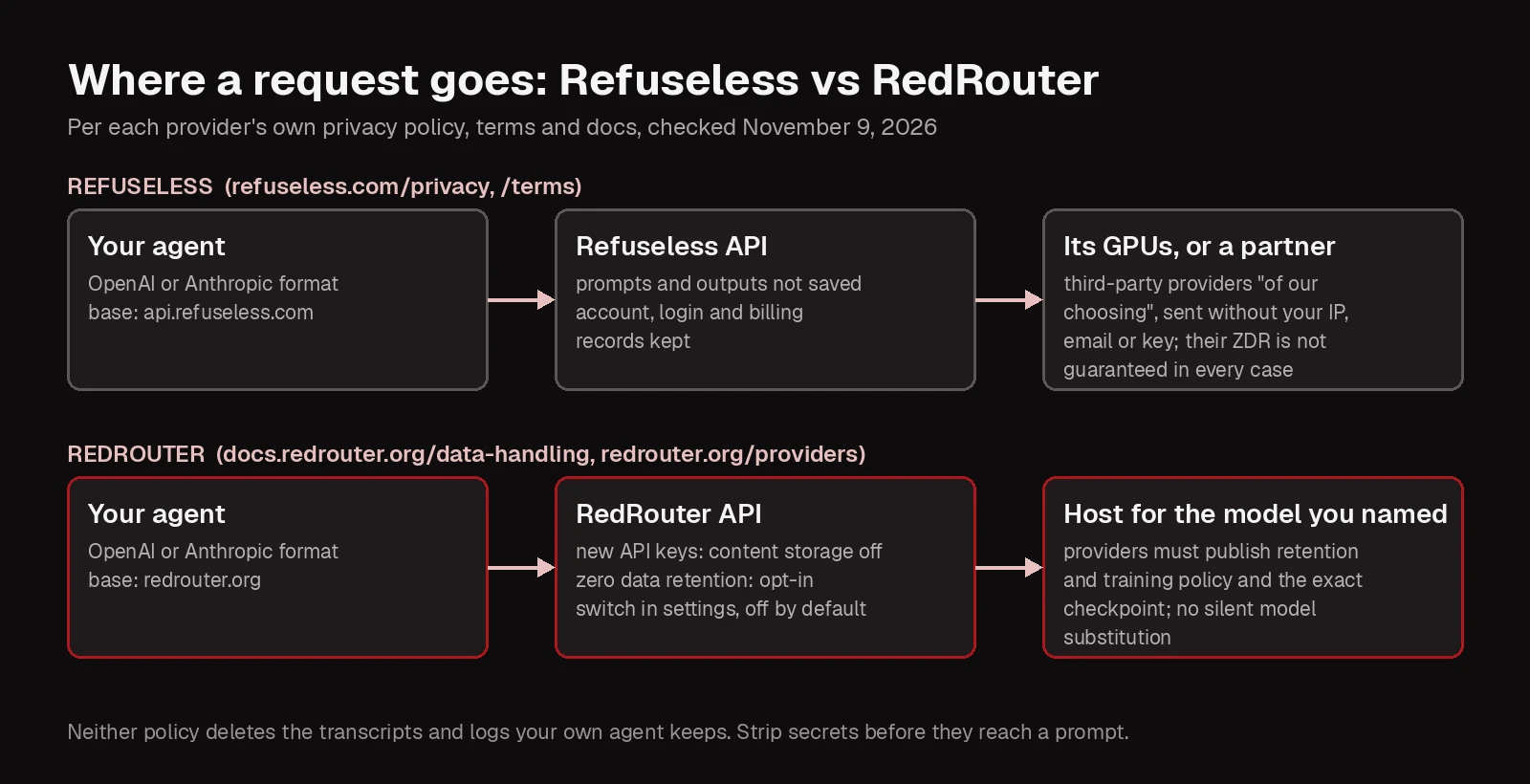
RedRouter also serves through upstream providers. Its data handling page says standard inference sends request content to the inference infrastructure that runs the model you selected. Before a provider can serve customers, RedRouter's providers page requires a published privacy policy and terms that state prompt logging, retention and training use, plus "honest model identity: the exact checkpoint and quantization behind each id, with no silent substitution." the models docs say RedRouter "does not substitute a different model when the selected one is unavailable."
For client work, that's the question to put to any provider: who else can see this prompt, and under whose written policy?
2. What's stored on the provider's side
Refuseless says prompts and outputs aren't saved, with account, login, payment and referral records kept. That's a clear default and worth crediting.
On RedRouter, new API keys start with content storage off at no surcharge. Older keys keep storage on, and browser chat and the Mac app store content unless account zero data retention is on. When storage is on, prompts and completions are encrypted for up to 30 days for abuse prevention, support, debugging and billing disputes, and backups may persist up to seven more days. Zero data retention is an opt-in switch in Settings, off by default; see the data-handling docs for which plans include it and what it costs. Usage metadata is still recorded for billing. The full version is in what RedRouter keeps.
If your engagement letter cares about this, check the key you're actually using with GET /v1/key before the first client prompt.
3. A model built for the security workflow
Both catalogs carry abliterated GLM and DeepSeek models. RedRouter labels its modified models RR and adds no refusal layer on top (security). It also lists red-cyber-1, a beta model described as "for authorized penetration testing and red-team work," with tool calling, structured output and a 1m context. Its underlying model and hosting details aren't disclosed, so test it on your own authorized tasks before you trust it. That's true of every model here.
Refuseless publishes base-model benchmark scores on its home page and notes that "each score is the base model's own published number, not a refuseless eval." RedRouter doesn't post leaderboard numbers; benchmarks we don't run explains why.
4. Proof that the problem is real
The reason most people search for a Refuseless alternative, or for Refuseless itself, is a mainstream assistant stopping mid-task on authorized work. RedRouter keeps source-checked examples of exactly that in the refusal archive, for example Claude Code refusing a defensive review of the user's own code. We didn't find an equivalent public archive on refuseless.com (November 9, 2026). An archive isn't a promise about any model's behavior, but it does show what kinds of tasks we're building for.
Refuseless vs RedRouter, side by side
| Refuseless | RedRouter | |
|---|---|---|
| Stated focus | "cyber-capable models for security teams" | Low-refusal inference for authorized security work (security) |
| OpenAI-compatible API | Yes, api.refuseless.com/v1 (chat, responses, completions, embeddings) | Yes, redrouter.org/v1 (Chat Completions and Responses) |
| Anthropic Messages API | Yes, /v1/messages | Yes, redrouter.org/v1/messages |
| Claude Code and OpenCode | Documented on its SDKs page | Documented in the Claude Code recipe and agent setup guide |
| Security-specific model | Lineup of abliterated GLM and DeepSeek IDs | RR models plus red-cyber-1 (beta) |
| Prompt storage | Prompts and outputs not saved | New API keys store no content; zero data retention is an opt-in switch in Settings, off by default |
| Third-party serving | May route to providers "of our choosing"; their ZDR not guaranteed in every case | Served by vetted upstream providers that must publish retention and training policy and the exact checkpoint, with no silent model substitution (providers) |
| Hardware-isolated option | None found on its pages (Nov 9, 2026) | Confidential Inference, via support (private vs confidential inference) |
| Plans | Prepaid balance; "no" free tier, with an occasional first-deposit bonus | Pay as you go from $10, or plans with included usage and higher parallel limits; first-deposit bonus on free credits |
| Payment | Card, BTC, ETH, USDT, USDC, XMR | Card or USDC |
| Refusal evidence | None found on its pages (Nov 9, 2026) | Refusal archive |
No price table here. Per-token prices change often on both sides, and Refuseless's own pricing page is the only place to read its current rates. On RedRouter, GLM 5.3 Flash Red is the usual starting point for agent work: $0.25 input, $0.10 cached input and $1.00 output per 1M tokens, a 1,048,576-token context and tool calling (docs.redrouter.org/models, November 14, 2026). Other models are on the pricing page.
Switching a security agent from Refuseless to RedRouter
Since both providers speak the same two API formats, the cutover is a base URL, a key and a model ID. For Claude Code, set the base URL to the origin. Claude Code appends /v1/messages itself:
export REDROUTER_API_KEY="your-redrouter-api-key"
export ANTHROPIC_BASE_URL="https://redrouter.org"
export ANTHROPIC_AUTH_TOKEN="$REDROUTER_API_KEY"
export ANTHROPIC_API_KEY=""
export ANTHROPIC_MODEL="glm-5.3-flash-red"
export ANTHROPIC_DEFAULT_SONNET_MODEL="glm-5.3-flash-red"
export ANTHROPIC_DEFAULT_OPUS_MODEL="glm-5.3-flash-red"
export ANTHROPIC_DEFAULT_HAIKU_MODEL="glm-5.3-flash-red"
export CLAUDE_CODE_SUBAGENT_MODEL="glm-5.3-flash-red"
claude --permission-mode plan
For OpenCode, swap the provider block in opencode.json: baseURL becomes https://redrouter.org/v1, the key becomes your REDROUTER_API_KEY, and the model ID comes from the catalog. OpenCode stores /connect keys separately, so run /connect again after the swap. The full config is in our OpenCode and Cline guide.
One difference to plan for: RedRouter caps output at 8,192 tokens per request on most models (32,768 on GLM 5.3 RR). Refuseless's own OpenCode configs list higher output limits. Long single-shot reports should be split into sections either way.
Before the first real run:
- Put the written scope in the working directory.
- Confirm content storage is off on the key, or turn on zero data retention in settings, before client data touches a prompt.
- Send one nonsensitive request and check the model ID in the usage dashboard.
- Only then give the agent tools, files or a proxy session. The Claude Code and Burp workflow shows an offline first pass.
When RedRouter isn't the Refuseless alternative you need
- You need image input on an abliterated GLM model. Refuseless says its GLM 5.3 flash abliterated accepts images; RedRouter's GLM 5.3 Flash Red is text-only, and image input sits on some standard models instead (models).
- You need embeddings from the same provider. Refuseless documents an embeddings endpoint; RedRouter's docs don't list one.
- You want to pay in btc, eth or xmr. RedRouter takes card or usdc.
- Your work isn't authorized. Both providers' terms prohibit testing systems you don't own or aren't allowed to test, and we won't help with it.
If you're comparing more than one vendor, the same tradeoffs for other providers are in Venice AI alternative for security work and OpenRouter uncensored models vs a security API.
FAQ
What's the best Refuseless alternative for pentesting?
For authorized pentests, red teams and bug bounty, RedRouter is the closest Refuseless alternative built around security work: abliterated RR models plus red-cyber-1, OpenAI and Anthropic formats, published provider requirements and a refusal archive. Test any provider on your own scoped tasks before client work.
Does Refuseless work with Claude Code?
Yes. Refuseless documents an Anthropic-compatible /v1/messages endpoint and a Claude Code setup on its SDKs page (November 9, 2026). RedRouter works the same way: set ANTHROPIC_BASE_URL to https://redrouter.org.
Refuseless vs RedRouter: which one stores less?
Refuseless says it never saves prompts or outputs, but some requests may go to third-party providers whose zero data retention it can't guarantee in every case. On RedRouter, new API keys store no content, and account zero data retention is an opt-in switch in Settings, off by default. Usage metadata is kept on both.
Are abliterated models safe to use for security research?
They're as safe as your process. Abliteration lowers refusals, it doesn't make a model correct. Keep scope written down, keep manual approvals on, and verify every finding against tool output before it goes in a report.
Sources
All read November 9, 2026.
- Refuseless home page: https://refuseless.com/
- Refuseless docs index: https://docs.refuseless.com/llms.txt
- Refuseless models: https://docs.refuseless.com/models.md
- Refuseless SDKs (Claude Code, OpenCode): https://docs.refuseless.com/sdks.md
- Refuseless privacy policy (last updated October 24, 2026): https://refuseless.com/privacy
- Refuseless terms of service (last updated October 24, 2026): https://refuseless.com/terms
- RedRouter models and prices: https://docs.redrouter.org/models
- RedRouter data handling: https://docs.redrouter.org/data-handling
- RedRouter Claude Code recipe: https://docs.redrouter.org/claude-code
- RedRouter provider requirements: https://redrouter.org/providers
- RedRouter red-cyber-1: https://redrouter.org/models/red-cyber-1
- RedRouter pricing and plans: https://redrouter.org/pricing
- RedRouter terms: https://redrouter.org/terms
- Cover photo: "Brakes for motorcycles" by Jah 256, CC0 1.0, via Wikimedia Commons