 redrouter

On November 13, 2026, the FBI released FLASH-20261113-001, "Threat Overview of ARTEX Autonomous Penetration Testing Framework." The ARTEX FBI FLASH says threat actors have weaponized ARTEX, an open-source, LLM-driven agentic platform, "to automate multiple phases of cyber intrusions at machine speed, from reconnaissance through data exfiltration," and that they have done so since at least August 2026. This post sums up what the FLASH says, lists its indicators and mitigations, and shows how defenders can use the same kind of tooling, pointed only at their own systems, to find and fix what ARTEX threat actors would hit first.
The FBI's Cyber Branch account announced the FLASH on X the same day (11:00 AM PT), and the full report is on IC3 as a TLP:CLEAR PDF: ic3.gov/CSA/2026/261113.pdf. TLP:CLEAR means it can be shared without restriction. Everything below that is attributed to the FLASH comes from that PDF, read on November 14, 2026.
Authorized work only. Every testing step in this post is for systems you own or have written permission to test. RedRouter's terms prohibit using the service to "attack, access, or test systems you do not own or are not authorized to test." We already have a setup guide for running ARTEX with RedRouter for authorized pentests; this post is the defender's side of the same tool.
What the ARTEX FBI FLASH says
The FLASH is short, and most of it is a threat summary, a MITRE ATT&CK table, indicators and recommendations. The key points:
- What ARTEX is. An "autonomous, multi-agent penetration testing platform written in Go" that turns natural-language goals into commands run by agents, "requiring minimal human interaction beyond initial objective setting." It ships no model of its own and plugs into external LLM providers.
- Who is targeted. A "variety of malicious cyber actors" have hit financial services, government, technology, defense, semiconductor, energy, healthcare, manufacturing, telecommunications and legal organizations worldwide. The FBI names no state sponsor.
- How fast. Some intrusions went "from initial targeting to privileged access in under three hours" (citing Microsoft).
- Named campaigns. Attacks on South Korean financial institutions that exposed personal information on about 67,000 people, and a supply chain compromise through ConnectWise Cloud Backup that reached more than 2,250 downstream tenants.
- Availability. The original developer, "Autumn-27," took the GitHub repository down on October 8, 2026, but forks, archived copies and a commercial "ARTEX PRO" version keep it in circulation. Censys counted more than 1,600 publicly exposed ARTEX consoles in early November.
- What it is good at. "Exploitation of Overlooked Attack Surfaces": partner and supplier portals, mobile backends, employee apps, sales-support systems, legacy services and third-party integrations. That point drives most of the defensive advice below.
The FLASH also says ARTEX's traffic is "forensically noisy" and likely to trip alerts, but that its speed leaves little time to respond. ARTEX threat actors are not quiet. They are fast.
Coverage and related reporting
The Record covered the FLASH on November 13. The same day, Amazon Threat Intelligence published what its MadPot decoys captured from ARTEX agents that sent their campaign memory to fake LLM APIs. Its most prominent campaign was large-scale theft of AI API keys, "in which stolen keys paid for the LLM inference powering further credential hunting." Earlier reporting the FLASH cites includes Microsoft Threat Intelligence on Storm-3358 (November 2026) and Google Threat Intelligence Group and Mandiant (October 30, 2026), which also named HexStrike, PentAGI and CAIRN. Together they show AI pentest framework abuse moving from one-off experiments to routine criminal operations, and the FLASH's own footnote 2 cites a Microsoft report from October 21, 2026, titled "AI-driven, large-scale nation-state campaign using ARTEX enables supply chain compromise."
How ARTEX threat actors operate (from the FLASH's ATT&CK table)
Nothing in the table is new. The FLASH lists no CVEs. It describes ordinary weaknesses found and chained very quickly:
| Phase | What the FLASH says ARTEX agents did |
|---|---|
| Initial recon | Mapped effective permissions of Azure credentials (SAS tokens, service principals, Kudu credentials, storage keys) with sub-second checks; tested IAM permissions with DryRun flags; fuzzed web directories across 500+ requests |
| Initial access | Unsigned SAML assertions, XXE, anonymous file upload, SSRF, hardcoded admin passwords in SPA JavaScript bundles, missing API authentication, command injection, SSTI, SQL injection, IDOR, weak admin credentials, stolen VPN configs, abused partner-tenant trust |
| Persistence | JSP and PHP web shells, Kudu admin APIs, open-source RATs (WISP, vshell, AdaptixC2), new SSH keys, credentials added to existing OAuth apps |
| Privilege escalation | High-value IAM roles on new instances, Kerberoasting, DCSync, forged admin tokens from unrotated keys, cloud metadata queries via XXE |
| Internal recon and lateral movement | PowerShell enumeration of domain controllers (over 110,000 AD objects in one case), LAPS reads, checks for hosts without EDR, Pass-the-Ticket and Pass-the-Hash attempts (blocked by endpoint protection) |
| Collection and exfiltration | Bulk SQL and blob reads, mailbox reads, 100 GB staging volumes, command output sent to rotating webhook.site endpoints |
| Command and control | Residential proxies, Tor, SOCKS, Chisel and SoftEther tunnels |
ARTEX IOCs from the FLASH
The FBI asks organizations to vet these before blocking. Many are cloud or VPN addresses that may since have been reassigned, so treat them as "historically observed infrastructure" and corroborate with your own telemetry. They are defanged as in the FLASH.
| Indicator | Context in the FLASH | Source cited |
|---|---|---|
| 38.244.50[.]120 | ARTEX host and open directory (South Korea financial campaign) | CrowdStrike, Censys |
| 144.172.64[.]60, 144.172.64[.]99, 144.172.64[.]128 | ConnectWise campaign sign-ins and Graph API activity | Microsoft |
| 187.15.88[.]186, 187.15.90[.]217, 187.15.89[.]186 | Graph API access via compromised apps (transient VPN IPs, October 15–16, 2026) | Microsoft |
| 101.53.80[.]20, 205.214.59[.]31, 124.155.252[.]63, 154.201.79[.]246, 23.248.249[.]90, 23.158.220[.]98, 103.248.148[.]84, 203.160.133[.]172, 209.209.85[.]38 | Proxy IPs (South Korea financial campaign) | CrowdStrike |
| 199.19.95[.]66, 199.19.95[.]67, 199.19.95[.]68 | WISP C2 nodes (Storm-3358, active as of November 6, 2026) | Microsoft |
| 91.92.240[.]238, 85.11.168[.]45, 178.16.54[.]129, 31.77.229[.]35 | ARTEX servers (Storm-3358, active as of November 6, 2026) | Microsoft |
| 85.11.167[.]52 | C2 server (Storm-3358, active as of November 6, 2026) | Microsoft |
| xcai[.]pro | LLM API reseller (South Korea financial campaign) | CrowdStrike |
The behavioral indicators are more durable than the IPs:
- Outbound calls to LLM APIs from hosts that have no reason to make them. The FLASH lists api.anthropic.com, api.deepseek.com, open.bigmodel.cn and api.x.ai, and says to investigate unexpected calls "alongside other suspicious activity." In its reporting request it also asks about "self-hosted LLM gateway or reseller software" and "unfamiliar LLM proxies or resellers in egress logs."
- High-frequency automated requests with sequential enumeration against login and search endpoints.
- Outbound transfers of structured personal data over HTTPS to unauthorized destinations.
- Web shells:
.aspxor.jspfiles in unexpected web application paths. - Agent fingerprints from the reporting request: compressed bursts of activity, many failed attempts with small incremental changes, and "multiple sub-agents overwriting each other or generating duplicate requests."
One practical note on the first item: if your own teams use LLM APIs, including RedRouter at redrouter.org, write down which hosts and which services are expected to call them. An approved list makes an unexpected caller stand out, whichever provider it calls.
The FLASH's mitigations, condensed
The recommendations section is long. Its main points:
- Reduce the external attack surface. Inventory every internet-facing app, including the peripheral ones listed above. Keep cloud admin, Kudu/SCM publishing endpoints, hypervisors and backup platforms on trusted networks only. Disable basic publishing authentication where you don't need it. Require architecture review before anything gets a public IP. Move enterprise apps behind Zero Trust access where you can.
- Harden identity. Apply least privilege to multi-tenant app permissions and consent grants. Monitor credential additions, privilege assignments and app-only activity. Review successful and failed service-principal sign-ins separately, and don't limit the review to published IPs.
- Strengthen applications. Rate-limit high-impact business APIs. Alert on sequential lookups and unusually high records-per-session on partner and employee portals. Enforce server-side authorization. Don't return stack traces, SQL errors or internal paths to unauthenticated users. Scan repos, images, build artifacts and pipelines for secrets, and rotate what you find.
- Preserve evidence and respond. Keep Entra sign-in and audit logs, Purview audit records and SIEM data, and don't delay urgent containment while you wait for exports. Customers of the affected ConnectWise application have specific steps in the FLASH: review activity from at least October 1, 2026, search by application ID rather than display name, and don't delete enterprise apps as a first response.
Report incidents to your local FBI field office or IC3. The FLASH lists what to include, from ARTEX console screenshots to token-consumption and API billing anomalies.
How to defend against ARTEX with the same kind of tooling
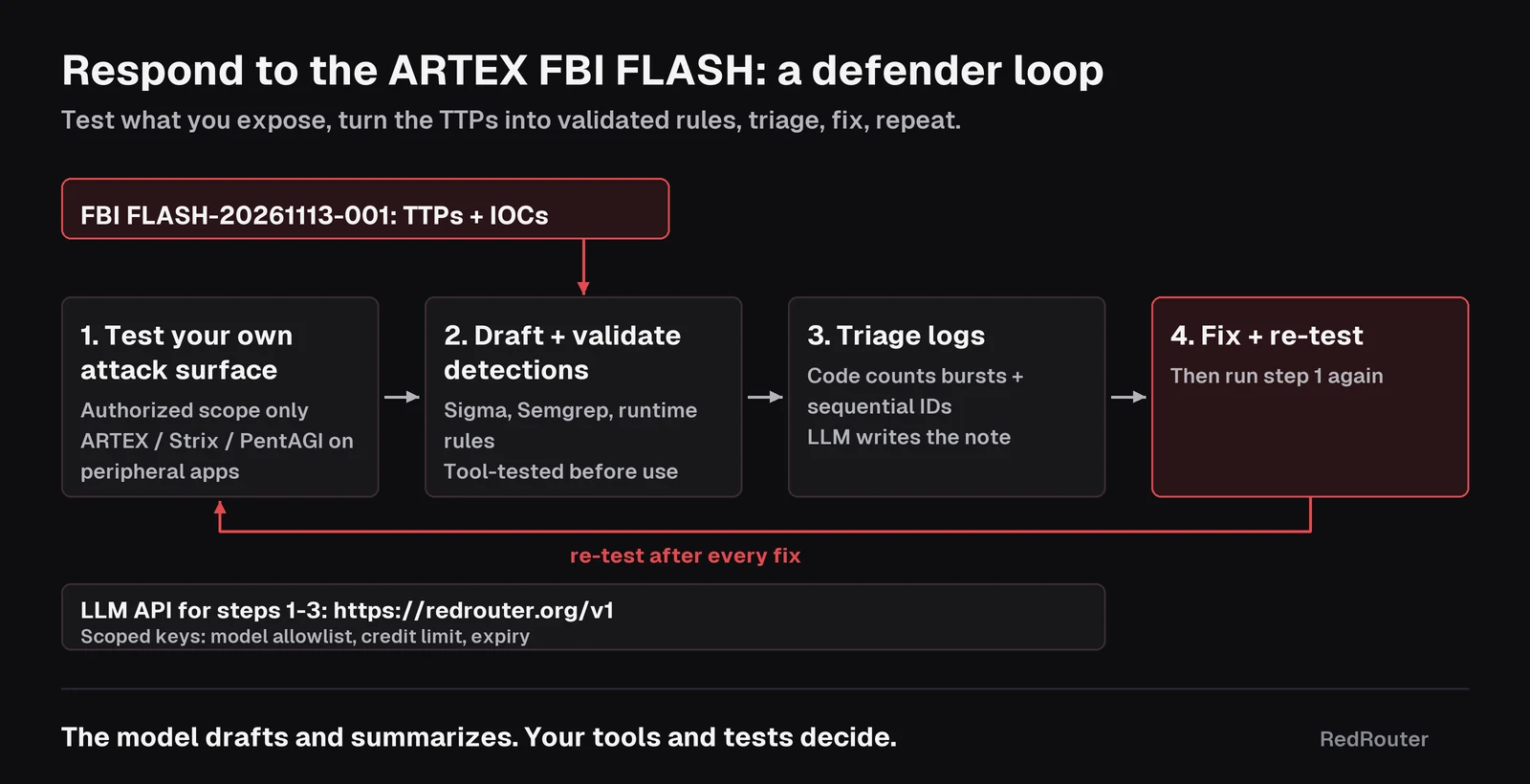
The FLASH's main lesson is that ARTEX finds the systems nobody is watching, and finds them fast. The defense is to look at those systems first, with authorization, and to turn what you find into fixes and detections before an attacker's agent does the same work. An LLM API helps with three parts of that.
1. Test your own attack surface first
Start from the FLASH's inventory advice, not from a tool. List the partner portals, mobile backends, old admin panels and one-off business-unit apps, and get written sign-off on what is in scope. Then run an agentic tester against that list in a controlled window:
- ARTEX itself, if your red team wants to see exactly what the attackers' tool finds. Our ARTEX setup guide covers which fork to use, how to point it at an OpenAI- or Anthropic-compatible API, and why you should build from source: trojanized ARTEX images were reported on Docker Hub in early November. Keep the console on loopback. The 1,600-plus exposed consoles in the FLASH are other people's mistakes, not a template.
- Strix, which is better suited to web apps and APIs and runs its tools in a Docker sandbox. The scope builder writes a pull-request workflow and scope file for your own app.
- PentAGI, HexStrike AI or Cairn, the other frameworks named in the threat-intel reporting, each with its own guide.
Map every finding back to the FLASH's ATT&CK table. A hardcoded admin password in a JavaScript bundle, an unauthenticated API route, or an IDOR on a customer endpoint is exactly the kind of initial access listed there.
For the model behind these agents, RedRouter serves an OpenAI-compatible API at https://redrouter.org/v1 and an Anthropic-compatible API at https://redrouter.org (no /v1), per its compatibility guide. GLM 5.3 Flash Red (glm-5.3-flash-red) costs $0.25 per 1M input tokens, $0.10 per 1M cached input tokens and $1.00 per 1M output tokens, with a 1,048,576-token context window and tool calling (model page, pricing). red-cyber-1 (Beta), RedRouter's featured model for authorized penetration testing and red-team work, costs $0.28, $0.10 and $1.10 per 1M tokens on the same basis (model page). Prices change, so check the models docs before you budget a run.
2. Turn the FLASH into validated detections
The ATT&CK table is a ready-made backlog for detection engineering. An LLM can draft the first version of each rule. A real tool has to prove it works before it ships.
- SIEM and log rules. Turn the cloud and identity items (DryRun permission probing, credential additions to OAuth apps, Kerberoasting, DCSync) into Sigma rules. Our guide to generating Sigma and YARA rules with an LLM shows the draft, convert and test loop. YARA fits the web shells and RAT samples if your IR team has them.
- Code rules. Several initial-access items are code flaws you can catch before deploy: hardcoded credentials in front-end bundles, SSTI, command injection, SQL injection and XXE. Our post on generating Semgrep rules with an LLM shows a model's first rule failing
semgrep --validateand--test, and what it takes to get one that passes. - Runtime rules. Web shells written into app directories,
curlornetcatpulling down a RAT, and tunnels such as Chisel are runtime events. A runtime rule engine such as Falco can catch them on Linux hosts and containers; our guide to generating Falco rules with an LLM shows the full validate-and-replay loop. Test each rule against benign activity before you trust it.
Whatever the format, the rule is the same: model output is a draft, not proof. Validate every rule with the tool that runs it, and test it against known-good traffic so it doesn't page your on-call for every cron job.
3. Triage logs with an LLM, after a deterministic pass
The FLASH's behavioral indicators (bursts, sequential enumeration, many failed attempts with small changes) are countable. Count them with code first, then hand the short, suspicious slice to a model for a written triage note. Don't paste a day of raw logs into a prompt.
Here is a small pre-filter for web access logs in the common "combined" format. It ranks source IPs by their densest 10-second burst, the longest run of sequential numeric IDs on one route (the FLASH's "sequential lookups") and their authentication failures:
import re, sys, json
from collections import defaultdict
from datetime import datetime

LINE = re.compile(r'(?P<ip>\S+) \S+ \S+ \[(?P<ts>[^\]]+)\] "(?P<method>\S+) (?P<path>\S+) [^"]*" (?P<status>\d{3}) \S+ "[^"]*" "(?P<ua>[^"]*)"')
NUM = re.compile(r'/(\d+)(?=/|$|\?)')

def summarize(lines, window=10):
    by_ip = defaultdict(list)
    for line in lines:
        m = LINE.match(line)
        if m:
            ts = datetime.strptime(m["ts"], "%d/%b/%Y:%H:%M:%S %z")
            by_ip[m["ip"]].append((ts, m["path"], int(m["status"]), m["ua"]))
    out = []
    for ip, reqs in by_ip.items():
        reqs.sort()
        times = [r[0].timestamp() for r in reqs]
        burst, j = 0, 0
        for i, t in enumerate(times):
            while t - times[j] > window:
                j += 1
            burst = max(burst, i - j + 1)
        ids = defaultdict(list)
        for _, path, _, _ in reqs:
            m = NUM.search(path)
            if m:
                ids[NUM.sub("/{id}", path, count=1)].append(int(m.group(1)))
        seq = max((sum(1 for a, b in zip(v, v[1:]) if b - a == 1) for v in ids.values()), default=0)
        fails = sum(1 for r in reqs if r[2] in (401, 403))
        out.append({
            "ip": ip, "requests": len(reqs), "distinct_paths": len({r[1] for r in reqs}),
            f"max_requests_in_{window}s": burst, "auth_failures": fails,
            "sequential_id_steps": seq, "user_agents": sorted({r[3] for r in reqs})[:3],
        })
    out.sort(key=lambda s: (s[f"max_requests_in_{window}s"], s["sequential_id_steps"], s["auth_failures"]), reverse=True)
    return out

if __name__ == "__main__":
    print(json.dumps(summarize(open(sys.argv[1]))[:5], indent=2))
We ran it on a synthetic log (documentation IP ranges only) with normal browsing, one client walking /api/customers/1000 to /api/customers/1119, and one client spraying /login. The top two results:
{"ip": "203.0.113.77", "requests": 120, "distinct_paths": 120, "max_requests_in_10s": 66,
 "auth_failures": 40, "sequential_id_steps": 119, "user_agents": ["python-httpx/0.28"]}
{"ip": "192.0.2.15", "requests": 30, "distinct_paths": 1, "max_requests_in_10s": 11,
 "auth_failures": 30, "sequential_id_steps": 0, "user_agents": ["Go-http-client/1.1"]}
Then send only those summaries to a model and ask for a triage note. This part uses RedRouter's OpenAI-compatible endpoint. We did not run it for this post, so test it on your own data first:
import json, os
from openai import OpenAI

client = OpenAI(base_url="https://redrouter.org/v1", api_key=os.environ["REDROUTER_API_KEY"])
top = summarize(open("access.log"))[:5]

resp = client.chat.completions.create(
    model="glm-5.3-flash-red",
    messages=[
        {"role": "system", "content": (
            "You are a SOC analyst. For each source, say whether it matches these FBI FLASH "
            "FLASH-20261113-001 behaviors: compressed bursts, sequential enumeration of records, "
            "many failed attempts with small changes, duplicate requests. Quote the numbers you "
            "rely on, give a confidence, and list the next log query to run. Do not invent data.")},
        {"role": "user", "content": json.dumps(top)},
    ],
)
print(resp.choices[0].message.content)
The model writes the note. The counts come from code. Your analyst decides. That split keeps a model from hallucinating an incident or talking you out of a real one.
Before you send logs anywhere, decide what you're comfortable sharing. On RedRouter, new API keys default to store_content: false, so prompts and completions aren't kept in request logs. Account-wide zero data retention (ZDR) is a separate opt-in setting that is off by default; the data handling docs explain eligibility, and what RedRouter keeps explains it in plain terms. Strip or hash fields you don't need, such as customer names, before they leave your network.
Protect your own LLM keys
Amazon's MadPot findings deserve their own section. In the campaign Amazon describes, ARTEX agents hunted for exposed AI API keys in code, packages, container layers and LLM gateways (One API, New API, LiteLLM and others), then used the stolen keys to pay for more hunting. If your team uses any LLM API, your keys are a target.
The fixes are the same ones the FLASH recommends for every other secret: keep keys out of repos, client bundles and images, scan for them continuously, and rotate quickly. On RedRouter, the authentication docs list per-key controls that limit the damage of a leak:
- A model allowlist so a key can call only the IDs that app needs.
- A credit limit, either lifetime or resetting daily, weekly or monthly.
- An expiry date, fixed when the key is created.
- Pause and revoke. Pausing is reversible. Revoking is permanent. If a key is exposed, revoke it, replace it, and review Usage for activity you don't recognize.
GET /v1/keyto check a key's limits, remaining amount, allowed models and storage setting.
Give each agent, CI job and environment its own key with a small limit. Then a leaked pentest key costs you a capped amount and one rotation, not your whole balance.
FAQ
What is the ARTEX FBI FLASH?
It is FBI FLASH-20261113-001, "Threat Overview of ARTEX Autonomous Penetration Testing Framework," released November 13, 2026, as a TLP:CLEAR PDF on IC3. It describes how threat actors use ARTEX, maps their activity to MITRE ATT&CK, lists IOCs and gives mitigations.
Which sectors are ARTEX threat actors targeting?
The FLASH lists financial services, government, technology, defense, semiconductor, energy, healthcare, manufacturing, telecommunications and legal organizations, worldwide, since at least August 2026.
Should I block every IP in the FLASH?
Not blindly. The FBI says to investigate or vet the IOCs first, because cloud and VPN addresses get reassigned. Search your logs for them across the activity window, and treat the behavioral indicators as the longer-lasting signal.
Is it legal to run ARTEX against my own systems?
Running a testing tool against systems you own or have written authorization to test is the normal basis for a pentest, but check your contracts, cloud provider terms and local law, and the terms in the README of the exact ARTEX fork you use. Some forks forbid live testing entirely. Never point it at anything outside your written scope.
How does an LLM help defend against ARTEX?
It speeds up the same work the attacker automated: finding weak, overlooked systems before they do, drafting detection rules from the FLASH's TTPs, and writing triage notes from pre-filtered logs. Every finding and rule still needs tool evidence and human review.
Sources
- FBI, FLASH-20261113-001: Threat Overview of ARTEX Autonomous Penetration Testing Framework, November 13, 2026 (TLP:CLEAR). Announced by @FBICyberBranch on X, November 13, 2026.
- The Record, FBI flash alert says Artex tool automating cyberattacks at 'machine speed', November 13, 2026.
- Amazon Threat Intelligence, Amazon Threat Intelligence observes threat actors running cybercrime campaigns with ARTEX AI agents, November 13, 2026.
- Microsoft Threat Intelligence, ARTEX abuse expands as cybercriminals target financial sector, November 6, 2026.
- Google Threat Intelligence Group and Mandiant, ARTEX and Friends: Enter Agentic Offensive Frameworks, October 30, 2026.
- RedRouter Docs: Models and pricing, Authentication and API keys, Data handling. Checked November 14, 2026.